

Last Updated on June 17, 2026
When your car isn’t running smoothly, it can be frustrating and stressful. But did you know that a simple tool called a vacuum pump plays a big role in fixing many common auto problems?
Whether you’re a car enthusiast or just want to understand how your vehicle works, knowing how vacuum pumps help in auto repair can save you time and money. You’ll discover the important ways vacuum pumps make repairs easier and more effective.
Keep reading to unlock these useful insights and take better care of your car.
Role Of Vacuum Pumps In Auto Repair
Vacuum pumps are important tools in auto repair shops. They help mechanics fix many car problems quickly and safely.
These pumps create a vacuum that makes it easier to test and repair different car parts. This article explains how vacuum pumps work in auto repair.
Testing Brake Systems
Vacuum pumps help check the brake system’s strength. They simulate pressure and find leaks in brake lines or cylinders. This ensures brakes work well and safely.
Checking Air Conditioning Systems
Mechanics use vacuum pumps to remove moisture and air from air conditioning systems. This process helps the AC work better and last longer.
Assisting Engine Diagnostics
Vacuum pumps help test engine parts like intake manifolds and vacuum lines. They find blockages or leaks that may cause engine problems.
Common Uses Of Vacuum Pumps In Auto Repair
- Brake bleeding and testing
- Air conditioning system evacuation
- Fuel system testing
- Engine vacuum leak detection
- Power brake booster testing
Comparison Of Vacuum Pump Types
| Type | Use | Advantages |
| Handheld Vacuum Pumps | Small jobs and testing | Portable and easy to use |
| Electric Vacuum Pumps | Longer or heavy-duty tasks | Consistent vacuum pressure |
| Vacuum Pump with Gauge | Precise measurement tasks | Accurate pressure readings |

Credit: www.reddit.com
Types Of Vacuum Pumps Used
Vacuum pumps play an important role in auto repair. They help remove air or gases from systems.
Different types of vacuum pumps serve different needs in automotive work. Choosing the right one improves repair quality.
Rotary Vane Pumps
Rotary vane pumps are common in auto repair shops. They use rotating vanes to create vacuum pressure.
These pumps are good for brake bleeding and air conditioning service. They are reliable and easy to maintain.
Diaphragm Pumps
Diaphragm pumps use a flexible membrane to move air or gases. They are oil-free and clean.
These pumps work well for fuel system testing and sensor calibration. Their design prevents contamination.
Piston Vacuum Pumps
Piston vacuum pumps create vacuum by moving a piston inside a cylinder. They can reach high vacuum levels.
These pumps are used for tasks needing strong suction, like vacuum forming or fluid evacuation.
Liquid Ring Vacuum Pumps
Liquid ring pumps use a liquid to form a ring that traps air and creates vacuum. They handle wet gases well.
- Good for engine testing
- Used in emission control diagnostics
- Can handle mixtures of air and liquids
Comparison Of Vacuum Pump Types
| Type | Best Use | Advantages | Limitations |
| Rotary Vane | Brake bleeding, A/C service | Reliable, easy maintenance | Requires oil, noisy |
| Diaphragm | Fuel testing, sensor calibration | Oil-free, clean operation | Lower vacuum levels |
| Piston | High vacuum applications | Strong suction power | Louder, heavier |
| Liquid Ring | Engine testing, emissions | Handles wet gases | Needs liquid, bulky |
Boosting Efficiency With Vacuum Pumps
Vacuum pumps play a key role in auto repair shops. They help mechanics work faster and with more accuracy. These tools create a vacuum that assists in many repair tasks.
Using vacuum pumps saves time and improves the quality of repairs. They reduce the effort needed for certain jobs and increase overall shop efficiency.
Improving Brake System Repairs
Vacuum pumps help remove air from brake lines quickly. This process, called bleeding brakes, is essential for safe driving. The pump creates a vacuum that pulls out trapped air and old brake fluid.
Enhancing Air Conditioning Service
Auto air conditioning systems need to be free of moisture and air. Vacuum pumps remove these unwanted elements before refilling the system with refrigerant. This step prevents damage and improves cooling.
Speeding Up Engine Maintenance
Vacuum pumps assist in testing engine components. They check for leaks in hoses and valves by creating vacuum pressure. This helps mechanics find problems fast and fix them before they get worse.
- Quickly removes air and moisture
- Helps detect leaks in vacuum lines
- Improves brake and AC system performance
- Reduces manual effort for mechanics
- Speeds up diagnostic and repair work
Common Uses Of Vacuum Pumps In Auto Repair
| Task | Benefit |
| Brake bleeding | Removes air for safer brakes |
| Air conditioning evacuation | Prevents moisture damage |
| Engine vacuum testing | Detects leaks and faults |
| Fluid transfer | Makes refilling easier and cleaner |
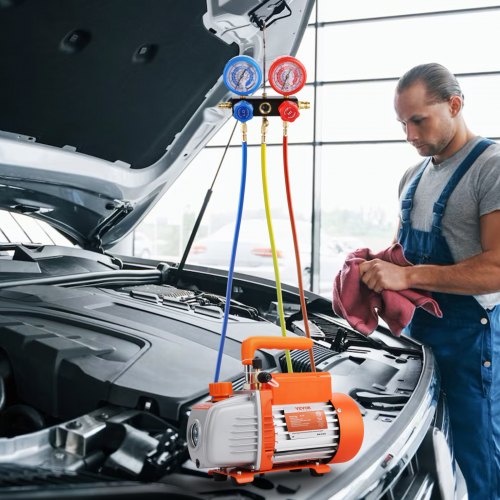
Credit: www.vevor.com
Common Applications In Vehicle Maintenance
Vacuum pumps are important tools in auto repair shops. They help mechanics perform many vehicle maintenance tasks with ease. These pumps create suction that moves air and fluids.
This article explains common uses of vacuum pumps in vehicle maintenance. It helps you understand why these pumps are useful for many repairs.
Brake System Maintenance
Vacuum pumps help in brake repairs by bleeding brake lines. Removing air from brake fluid is important for safe braking. The pump creates vacuum that pulls air bubbles out of the system.
Air Conditioning Service
Technicians use vacuum pumps to evacuate air and moisture from air conditioning systems. This process protects the system from damage and improves cooling efficiency. A clean, dry system works better.
Fuel System Testing
Vacuum pumps check fuel system leaks and pressure. Mechanics connect the pump to the fuel lines to test for leaks. If the vacuum does not hold, a leak is likely present.
Engine Diagnostics
Engine vacuum helps diagnose problems like valve leaks or bad gaskets. Mechanics use vacuum pumps to measure engine vacuum levels. Abnormal readings point to issues in engine performance.
Common Vehicle Maintenance Uses
- Brake bleeding and fluid replacement
- Removing moisture from air conditioning
- Detecting fuel system leaks
- Testing engine vacuum for diagnostics
- Power brake booster function check

Credit: omsautoparts.ie
Frequently Asked Questions
What Is The Main Use Of Vacuum Pumps In Auto Repair?
Vacuum pumps help remove air and fluids from car systems to ensure proper function and easy repair.
How Do Vacuum Pumps Improve Brake System Repairs?
They create suction to test brake boosters and remove air from brake lines for better brake performance.
Can Vacuum Pumps Detect Leaks In Car Engines?
Yes, they help find air or fluid leaks by creating pressure differences in engine parts.
Why Are Vacuum Pumps Important For Air Conditioning Repairs?
They remove air and moisture from the AC system, preventing damage and improving cooling efficiency.
How Do Vacuum Pumps Assist In Fuel System Maintenance?
They help remove air and contaminants from fuel lines, ensuring smooth fuel flow and engine performance.
Conclusion
Vacuum pumps play a key role in auto repair work. They help fix brakes, check engine systems, and remove air from fuel lines. Mechanics rely on these tools for accurate, fast repairs. Using vacuum pumps saves time and improves safety.
Cars run smoother and last longer with proper use. Understanding this tool helps anyone appreciate car maintenance more. Simple, effective, and essential—vacuum pumps make auto repair better every day.