

Last Updated on June 17, 2026
Have you ever wondered what makes your car’s electrical system tick? Understanding the difference between AC and DC in cars can save you from confusion and help you make smarter choices when it comes to your vehicle’s maintenance and upgrades.
Whether you’re curious about how your headlights shine or how your battery powers the engine, knowing these basics puts you in control. Keep reading, and you’ll discover the key facts that every car owner should know about AC and DC power.
Basics Of Ac And Dc Currents
Electricity powers many parts of a car. Two common types of electric current are AC and DC. Knowing their basics helps understand how car systems work.
This guide explains what alternating current and direct current are. It also shows how they differ in cars.
What Is Alternating Current
Alternating current (AC) changes direction many times per second. This means the electric charge flows back and forth. AC is used in some car systems like air conditioning.
What Is Direct Current
Direct current (DC) flows in one direction only. It is steady and does not change direction. Most car batteries and electronics use DC power.
How Ac And Dc Differ
| Feature | Alternating Current (AC) | Direct Current (DC) |
|---|---|---|
| Direction | Changes direction periodically | Flows in one direction |
| Source in Cars | Alternator | Battery |
| Use | Air conditioning, audio systems | Starting engine, lights, electronics |
| Voltage | Can be high or low, varies | Usually steady and low |
| Waveform | Sinusoidal wave | Flat line (constant) |

Credit: www.youtube.com
Role Of Ac And Dc In Vehicles
Cars use two types of electric currents: AC and DC. Each type has a special role in making the car work.
Understanding AC and DC helps explain how cars start, run, and power their systems.
Use Of Dc In Car Batteries
Car batteries store and supply direct current (DC). DC flows in one direction and powers many car parts.
The battery provides DC to start the engine and run electrical devices when the engine is off.
- Starts the engine with power to the starter motor
- Powers lights, radio, and dashboard when engine is off
- Charges when the engine runs through the alternator
Function Of Ac In Car Systems
Alternating current (AC) changes direction many times per second. Cars use AC mainly inside the alternator.
The alternator produces AC to charge the battery and power the car’s electrical systems while driving.
- Generates AC from engine movement
- Supplies power to electrical systems during driving
- Works with converters to charge the DC battery
Conversion Between Ac And Dc In Cars
Cars convert AC to DC to charge the battery and run DC devices. This conversion uses a device called a rectifier.
Sometimes, DC changes to AC for special parts, like electric motors in hybrid cars.
- Alternator creates AC from engine power
- Rectifier changes AC into DC for battery charging
- In hybrids, inverters convert DC back to AC for motors
Advantages And Disadvantages In Automotive Use
Cars use two types of electric currents: AC and DC. Each has benefits and challenges. Understanding them helps in automotive design and use.
This article explains the advantages of DC and the challenges of AC in vehicles. It focuses on their roles and effects.
Benefits Of Dc In Cars
Direct Current (DC) is common in cars because it powers many key systems. It flows in one direction, making it simple to control.
- Stable power supply for batteries and electronics
- Easy to store energy in car batteries
- Supports electric motors in electric vehicles
- Simple to convert for low-voltage car components
- Less energy loss in short-distance power use
Challenges With Ac In Vehicles
Alternating Current (AC) changes direction periodically. It is harder to use directly in cars and brings some issues.
| Challenge | Explanation |
|---|---|
| Complex conversion | AC needs extra parts to convert to DC for batteries |
| Higher energy loss | Power can reduce during conversion and transmission |
| Weight and space | AC systems require larger components, adding weight |
| Interference risk | AC can create electrical noise affecting electronics |
| Control difficulty | Speed and torque control of AC motors can be complex |

Credit: www.accu-machine.nl
Future Trends In Car Electrical Systems
Cars use both AC and DC electricity for different parts. The future will bring big changes in how cars use these types of power.
New technology will make car electrical systems smarter and more efficient. This will help improve car performance and reduce energy waste.
Emerging Technologies Using Ac And Dc
AC and DC power are used in new ways in cars. AC motors are common in electric cars because they are strong and easy to control.
DC power is used in batteries and electronics. New converters make it easier to switch between AC and DC power inside the car.
- AC motors improve electric car drive systems
- DC power supports battery charging and storage
- Converters help manage energy flow efficiently
Impact On Electric Vehicles
Electric vehicles use both AC and DC to run different parts. Battery packs store DC power, while AC motors move the car.
Future electric cars will have better power management. This means longer driving range and faster charging times.
- Improved battery life with better DC power use
- More efficient AC motors for smoother rides
- Faster charging with advanced power converters
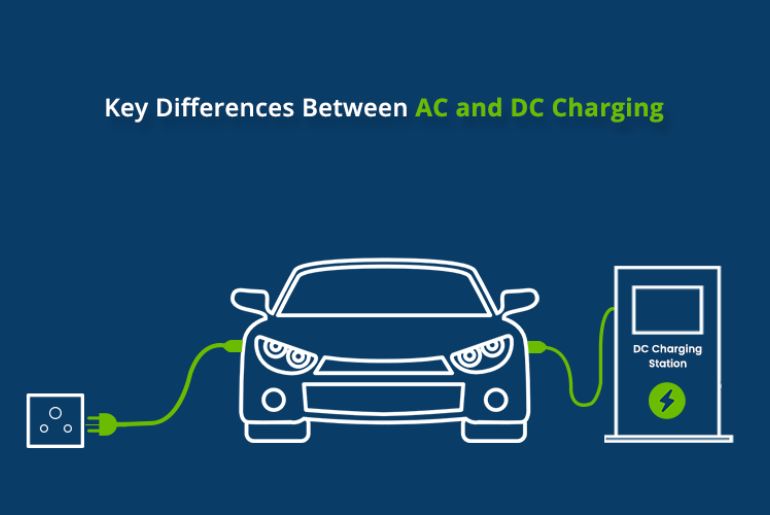
Credit: www.evmechanica.com
Frequently Asked Questions
What Is The Main Difference Between Ac And Dc In Cars?
AC is alternating current; DC is direct current. Cars mostly use DC for batteries and electronics.
Why Do Car Batteries Use Dc Instead Of Ac?
Car batteries store and supply steady DC power, which suits engines and electronic parts better.
Can Car Air Conditioners Work With Both Ac And Dc Power?
Car air conditioners run on DC power from the battery but use AC inside the system for cooling.
How Does The Car Alternator Convert Dc To Ac?
The alternator actually produces AC and then changes it to DC to charge the battery.
Which Is Safer For Car Electronics: Ac Or Dc?
DC is safer and more stable for car electronics, preventing damage and ensuring smooth operation.
Conclusion
AC and DC serve different purposes in cars. AC powers the air conditioning system efficiently. DC runs the car’s battery and electrical parts. Knowing their roles helps you understand car functions better. Both types of current keep your vehicle working smoothly.
Remember, each has its own benefits and uses. This knowledge can help with car maintenance. Simple facts, big difference. Keep this in mind next time you think about car electricity.